

When you live in a colder climate, a mid-winter beach vacation can be a panacea, when several months of darkness, colorlessness, and often freezing temps threaten to drive you into a funk. Such is the reason we include “a warm weather beach vacation” in our Grounding Gift Guide…sometimes treating yourself with one is a matter of health and wellbeing!
That said, we decided on Bonita Springs, FL for latitude relief, and recently reunited with loved ones there. Of course, it was the first rainy week FL had seen in a while, but we learned to jump on sunny day opportunities and make the most of time spent indoors (who knew three generations could so enjoy playing Continental Rummy together?). Besides inciting precious family time, the trip reminded us how healing being at the beach often is. Beaching is truly is one of “Nature’s simple cures.”
5 WAYS the Beach Nurtures and Heals Us
As a beach enthusiast, I’ve always been baffled when people say they don’t like the beach. To each his own…but I’ll argue, it’s their loss. Here’re a few reasons why:
1. Some sunshine is good for you.
Besides feeling nice on your skin, sunlight provides the light frequencies your body needs to manufacture Vitamin D and regulate circadian rhythms, both of which are essential for immune health, mood and overall vitality too (who wants to be sick and/or depressed all winter?).

You’ve probably heard about the health benefits of absorbing red and near-infrared (NIR) light wavelengths, a process called photobiomodulation… Did you know that sunning is also a form of photobiomodulation, where specific wavelengths interact with mitochondria to enhance ATP production and cellular energy efficiency?
According to our dad, Cardiologist Stephen Sinatra, MD, FACC, ten to twenty minutes of unprotected sun is all you need; if binge-bathing, be sure to apply sunscreen after the initial “nourishing” exposure to help prevent skin from burning and aging at an accelerated rate. Importantly, many sunscreens unfortunately contain toxic ingredients, so we recommend researching potential product choices in The Environmental Working Group’s SKIN DEEP database.
Always the black sheep of the family, Step doesn’t believe in sunscreen. Even though he spends lots of time in the sun, he rarely applies commercial sunscreen - only on his face, if needed.

Step sunning in Bonita Springs, FL, wearing Rhizal grounding shoes
His go-to? Coconut oil - a mild, natural sun protector and natural tanner. Admittedly, with our Sicilian blood, we tend to tan easily, and recognize that some people would turn as red as cooked lobsters if performing the same sun care routines. Only you know your body…go with a routine that serves it best!
2. The beach is rich in Vitamin G… “G” for “Ground.”
As long as some parts of you touches sand, you are grounded, and thus tapping into Earth’s restorative, natural electromagnetic energy. Simply planting your feet in the sand when sitting in a chair will do the trick, as will strolling or standing barefoot along the shoreline. If the sand feels prohibitively hot, we recommend wearing grounding sandals, which are specifically designed to allow Earth energy to pass into your feet.
While we’re on the subject, there’s another reason the beach is an optimal place to ground…
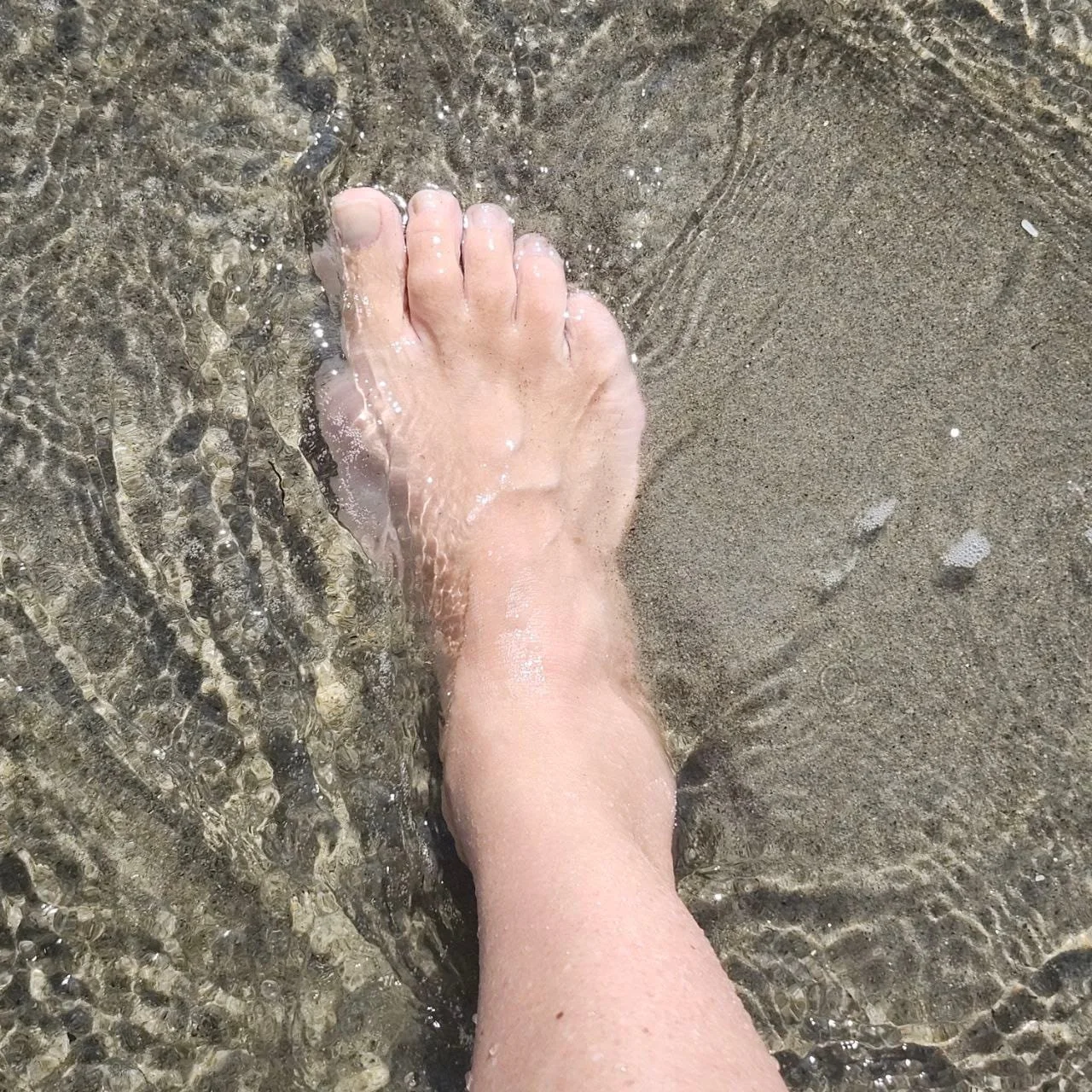
3. Ocean water – it’s the “secret sauce” of grounding and other beach benefits!
Ever notice how good you feel after swimming in the ocean? It may be due to increased grounding benefits.
Sea water is an excellent conductor of the Earth’s electrical energy. Other water is electro-conductive, as long as it contains some solids dissolved within it. Lakes and streams, for example, contain minerals, as well as ion-releasing soil and rocks, hence they transport electrical charge. Even tap water is conductive due to minerals and impurities. However, ocean water takes the cake. This is due to its salt content.
According to the U.S. Environmental Protection Agency, “Conductivity is a measure of the ability of water to pass an electrical current. Because dissolved salts and other inorganic chemicals conduct electrical current, conductivity increases as salinity increases.”
The ocean is about as saline as it gets, with significant amounts of sodium and chloride as well as 45 other minerals and metals. Hence, ocean water is the best to ground in if you have access to it. If you don’t, go jump in that river or pond, or even your bathtub (especially if your plumbing is metal)!
Perhaps this is also why, for over four thousand years, people have bathed in mineral-rich natural and thermal (think hot springs) waters in the name of healing. Spa Therapy or balneotherapy, as this practice is sometimes called, is thought to alleviate arthritis symptoms, reduce depression, stress, anxiety and improve sleep and cardiovascular health. Perhaps grounding has something to do with these results in some cases?
We believe that the health benefits of soaking in natural mineral pools and hot springs are very much due to the grounding effect, which the minerals and heat serve to amplify. That’s right - the warmer the water, the more conductive it is. So if you need to talk yourself into splurging on a Caribbean vacation, look at it from a grounding point of view!
In this short clip, our dad explains an underlying reason why beach vacationing feels so good.
4. WELCOME TO “RELAXATION STATION”
Whether you submerge in the ocean or not, it’s hard not to relax at the beach. After all, no one expects you to do anything there...that’s the point of going!
Where else (besides on an airplane or in a NYC park) do you see adults of all ages napping? With nothing but sand and sea, the beach offers the perfect excuse to unwind and recharge.
Well, grounding’s benefits include inducing a physiological relaxation response (via the parasympathetic branch of the autonomic nervous system), so some credit is due here.
But grounding’s not the only reason you’re relaxed at the beach. The overall sensory experience – on an optimal beach day (i.e. free of strong winds, pungent odors, rain or chilling temperatures) – also encourages stress relief. Steady sounds of seagull cries and waves lapping the shore, for example, help nudge brain activity out of fight-or-flight mode and into a relaxed, alpha-like state (assuming the ocean isn’t auditioning for a disaster movie that day). Then there’s the ocean spray, rich in negative ions—those tiny charged particles that, according to a growing body of research, may support better mood.
Whether it’s the ions, the rhythm, or just the fact that you finally put your phone down, the net effect is the same: your mind slows, your body exhales, and for a moment, you’re operating on beach time—which might just be the most scientifically underrated time zone there is.
Now, for those who like exercising at the beach…
5. SAND CHALLENGES YOU WITH A BETTER WORKOUT

Barefoot beach walking (or running) along the shoreline is great exercise for the circulatory as well as musculoskeletal systems. Of course, playing volleyball or catch games serve the same purpose, while arguably bringing more fun to the table.
Whichever barefoot activity you prefer, your balance and stability game goes next level when sinking in soft sand. The result is stronger feet and leg muscles and a greater cardio workout. Ocean swimming, too, is awesome exercise.
Our favorite? Yoga on the beach…It can be as vigorous or as relaxing as you like. But as with other physical beach activity, you’re working harder to move your legs and you’re grounded. Combined with yoga’s meditative aspect, you get the perfect trifecta of exercise, relaxation and recharge!
All said, taking that warm-weather beach vacation might be just what you need to get through winter with your sanity intact. Maybe I’m just projecting on you, or maybe I’m just trying to justify recent travel expenses. All I know is, locking Seasonal Affective Disorder (a.k.a. “SAD”) in your closet, gagged for a week while you bask, frolic, wade or stroll along the shoreline, can help diminish its power in your life.
In other words, the temporary happiness derived from tasting summer’s benefits can bridge the winter gap. A little sun, relaxation, grounding barefoot, and natural water immersion can go a long way when the timing is right.
References and Resources:
Visit our Studies page to review the science of grounding / Earthing
Sinatra, ST. “Is Sunshine Good for you?” Heartmdinstitute.com, last accessed April 15, 2026 at https://heartmdinstitute.com/alternative-medicine/why-some-sun-is-good-for-you/
Heiskanen V, Pfiffner M, Partonen T. Sunlight and health: shifting the focus from vitamin D3 to photobiomodulation by red and near-infrared light, Ageing Research Reviews, Vol. 61, 2020, 101089, ISSN 1568-1637, https://doi.org/10.1016/j.arr.2020.101089.
Karu T. Mitochondrial Mechanisms of Photobiomodulation in Context of New Data About Multiple Roles of ATP. Photomed. Laser Surg. 2010;28:159–160. doi: 10.1089/pho.2010.2789.
Blume C, Garbazza C, Spitschan M. Effects of light on human circadian rhythms, sleep and mood. Somnologie. 2019;23:147–56. doi: 10.1007/s11818-019-00215-x.
Ince FA, Nayar JC, Wong AL, McClelland JA, Holland AJA, Stern H, Abboud M, Mason RS, Dixon KM. Uncovering the efficacy of a natural homemade sunscreen in protection from ultraviolet radiation. Photochem Photobiol Sci. 2025 Jun;24(6):1017-1029. doi: 10.1007/s43630-025-00742-7. Epub 2025 Jun 7. PMID: 40481984.
University of Washington. “Mineral Make-up of Sea Water, last accessed April 19, 2026 at https://depts.washington.edu/embryology/index.php?id=mineral
Clean Water Team (CWT) 2004. Electrical conductivity/salinity Fact Sheet, FS3.1.3.0(EC). in: The Clean Water Team Guidance Compendium for Watershed Monitoring and Assessment, Version 2.0. Division of Water Quality, California State Water Resources Control Board (SWRCB), Sacramento, CA. Last accessed April 19, 2026 at https://www.waterboards.ca.gov/water_issues/programs/swamp/docs/cwt/guidance/3130en.pdf
U.S. Environmental Protection Agency. “Indicators: Conductivity,” last accessed April 16, 2026 at https://www.epa.gov/national-aquatic-resource-surveys/indicators-conductivity
Tyler, R. H., Boyer, T. P., Minami, T., Zweng, M. M., & Reagan, J. R. (2017). Electrical conductivity of the global ocean. Earth, planets, and space : EPS, 69(1), 156. https://doi.org/10.1186/s40623-017-0739-7
Encyclopedia Britannica. “Osmosis,” last accessed April 16, 2026 at https://www.britannica.com/science/osmosis
Encyclopedia Britannica. “Salinity,” last accessed April 16, 2026 at https://www.britannica.com/science/oceanography
Water Science School. “Why Is the Ocean Salty?” May 23, 2019. Last accessed April 15, 2026 at https://www.usgs.gov/water-science-school/science/conductivity-electrical-conductance-and-water
Carbajo, J.M., Maraver, F. Salt water and skin interactions: new lines of evidence. Int J Biometeorol 62, 1345–1360 (2018). https://doi.org/10.1007/s00484-018-1545-z
Global Wellness Institute. “Balneotherapy Spotlight,” last accessed April 16, 2026 at https://globalwellnessinstitute.org/wellnessevidence/balneotherapy/balneotherapy-spotlight/
Vishnam. “Balneotherapy: Exploring its History, Practices and Scientific Validity.” July 3, 2024. Last accessed April 15, 2026 at https://vishnam.com/2024/07/03/balneotherapy-exploring-its-history-practices-and-scientific-validity/
Chevalier G., Sinatra S.T. Emotional stress, heart rate variability, grounding, and improved autonomic tone: clinical applications. Integr Med. 2011;10:16–21.
Perez, V., Alexander, D. D., & Bailey, W. H. (2013). Air ions and mood outcomes: a review and meta-analysis. BMC psychiatry, 13, 29. https://doi.org/10.1186/1471-244X-13-29